Short answer: A pixel bot for Metin2 is not detected by anti-cheat systems because it never touches the game process at all. It reads only the image on your screen and simulates mouse and keyboard input. There is no memory access, no process hook and no modified game file, so there is nothing for detection to trigger on.
But that is only half the story: technical invisibility is not the same as being risk-free. The real risk when botting in Metin2 is not the software. It is how your character behaves in the game. Someone farming the same map for fourteen hours straight without a single break stands out to other players, no matter how clean the technology behind it is.
In this article
How anti-cheat systems actually detect bots
Discussions about "bot detection" tend to lump everything together. In reality there is only a limited set of methods an anti-cheat system can use to find a bot, and most of them require the software to touch the game process.
| Detection method | What it checks | Applies to a pixel bot? |
|---|---|---|
| Memory scan | Foreign read/write access to game memory | No: there is no access |
| Process hooks | Redirected function calls inside the process | No: nothing is hooked |
| File integrity | Modified client files or DLLs | No: no file is touched |
| Module list | Foreign DLLs inside the game address space | No: nothing is loaded |
| Packet analysis | Implausible or manipulated network packets | No: the client sends normally |
| Behavioural patterns | Playtime, click rhythm, movement patterns | Yes: this is the relevant one |
The first five rows describe what anti-cheat systems were historically built against. They target bots that place themselves inside the game. They read memory addresses to obtain mob positions, redirecting functions to trigger actions directly, or patching client files to change ranges.
All of these approaches are tempting from a developer's point of view because they deliver exact data. That is precisely why they are provable: a foreign process writing into another process's memory is an unambiguous, loggable event at operating system level.
Why a pixel bot sits outside those methods
A pixel bot inverts the approach. Instead of pulling data out of the game, it looks at the same thing you look at: the rendered image on the monitor. The technical difference between the two approaches is the heart of the matter.
Simplified, BeaTzVision works like this:
- Screenshot of the game window: several times per second, without touching the game itself.
- Analysis with OpenCV: template matching and colour analysis in HSV space locate targets, health bars, text elements or status indicators in the image.
- Decision: the logic determines the sensible action: attack, loot, move on, pause.
- Input simulation: mouse and keyboard events are sent to the window, exactly as any other software does.
From the game's perspective nothing unusual happens. It receives clicks and key presses, nothing more. The process is not opened, no handle is requested, no library injected. For an anti-cheat system looking for manipulation, there is simply nothing to find.
The core point
A pixel bot is technically indistinguishable from a human to an anti-cheat system, because both communicate with the game through exactly the same channel: screen output in, mouse and keyboard out.
The real risk: your in-game behaviour
Now the uncomfortable part. "Undetectable" applies to the software, not to how you play. When a ban happens, it is almost never because a scanner found something — it is because a person noticed something.
Patterns that stand out:
- Endless sessions. No human plays twelve hours without a single break. Two days in a row, even less so.
- No response when spoken to. Being messaged and never answering while visibly active gets you reported.
- Perfect repetition. Always the same route, the same order, the same distance to the target.
- Ignoring situations. A player dies next to you or attacks you, and your character just keeps farming.
A game master reviewing a report does not need technical analysis. They watch the behaviour for a few minutes. That is why "will my software be detected" is the wrong question. The right one is: does my character look like a human?
How to avoid mechanical behaviour
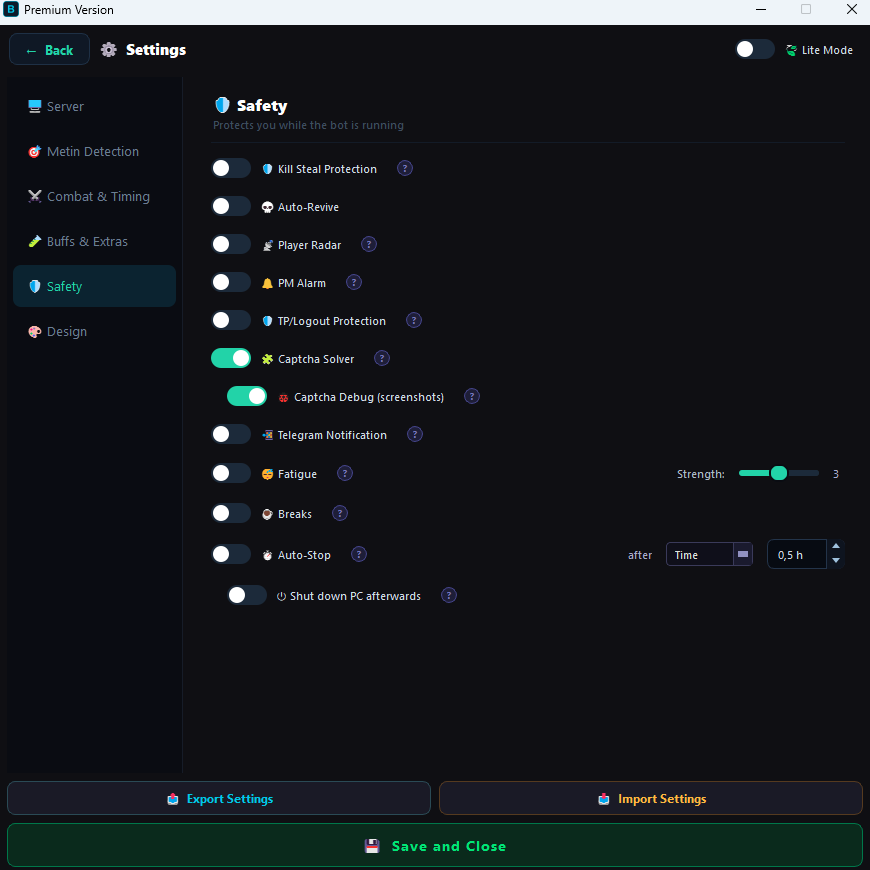
The anti-detection system in BeaTzVision grew out of exactly this insight. It does not make the bot "more invisible". Technically it already is. It makes sure the behaviour does not stand out:
- Live radar: detects nearby players and pauses before anyone can watch for long.
- PM alert: stops all actions the moment a private message arrives, preventing the classic case of someone messaging you, getting no reply, and reporting you.
- Fatigue simulation: reaction times slow down over the session, the way a real player slows after several hours.
- Random breaks: at configurable intervals, so no uninterrupted block of activity forms.
- Kill-steal protection: reacts to another player attacking your target instead of stubbornly continuing.
- Auto-revive: on death it stops cleanly and restarts instead of looping.
What this still cannot do
No anti-detection system replaces common sense. Running the bot around the clock on a busy map while never being online yourself carries a risk no software can configure away. Use is at your own responsibility and generally violates the terms of service of the respective server.
Conclusion
"Is there a Metin2 bot without ban" has a nuanced answer. On the technical level: yes. A pixel bot operates outside what anti-cheat systems can examine at all, and BeaTzTools has had no ban case from anti-cheat detection since launch.
On the practical level the responsibility stays with the user. A bot that simulates human behaviour and runs in controlled sessions is fundamentally different from one parked in a starting area 24/7. The technology removes the detection risk. It does not remove the behavioural risk.
Frequently asked questions
Can you get banned for botting in Metin2?
No anti-cheat system in Metin2 can detect a pure pixel bot, because no memory is read and no code is injected. The realistic risk is behavioural: a character farming visibly mechanically for hours can be reported by other players.
Can an anti-cheat system detect mouse movements as a bot?
Technically, an anti-cheat system cannot tell whether a click came from a driver or from input simulation. Input becomes suspicious only through its pattern: identical intervals, pixel-perfect repeated click positions and activity without any break.
Is a pixel bot safer than a bot using memory injection?
Yes, significantly so on a technical level. Memory injection and process hooks leave measurable traces inside the game process that anti-cheat systems specifically look for. A pixel bot operates entirely outside the game process.
Ready to try it yourself?
Join the BeaTzTools Discord and get access to BeaTzVision and BeaTzSignal, setup guides and support.
Try it free →